Most granted patents never generate a single dollar. That is not because the inventions are bad. It is because most inventors have no idea how to find out if their patent has real commercial value, or they wait too long to try.
If you have been sitting on a granted patent for a year or more wondering whether it is worth pursuing, you need an honest answer before more of your remaining patent term runs out. This guide walks you through exactly how to assess your patent’s commercial potential: what matters, what does not, and what to do next if you find real value there.
What Does It Mean for a Patent to Be “Worth Something”?
Quick Answer
A patent is commercially valuable when it covers a solution that companies actively need, cannot easily work around, and has enough remaining term for a buyer or licensee to earn a return. Value comes from four factors: claim breadth, market activity, remaining term, and the presence of willing licensees or buyers.
There is a difference between a patent being technically valid and a patent being commercially useful. The USPTO granting your application means your invention is novel and non-obvious. It does not mean any company will pay you for it.
Commercial value requires three things to line up at the same time: a real market selling products your patent covers, claims that are strong enough that companies cannot simply engineer around them, and a remaining term long enough that the deal makes financial sense for the other party. If all three are present, your patent is worth pursuing.
The 4 Factors That Determine Patent Value
Patent valuation professionals use three primary approaches: cost-based, market-based, and income-based. But for most solo inventors trying to get a first honest read, four practical factors will tell you most of what you need to know.
1. Claim Strength and Breadth
Your patent’s independent claims are what you actually own. Broad claims that cover a general principle are more valuable than narrow claims tied to a specific product configuration. Read your independent claims. If a company could build a product that achieves the same result without using your exact method or structure, your claims may be too narrow to enforce or license effectively.
If you are unsure how to read your claims, a USPTO patent search on similar patents can show you how broad competing claims typically are in your technology area.
2. Active Product Market
A patent covering a technology no one is using is worth very little. You want to find evidence that companies are actively selling products that fall within your claims, or that they are moving in that direction. Trade publications, product launches, industry reports, and LinkedIn job postings from companies in your space are all signals that your technology has an active market.
3. Remaining Patent Term
Utility patents last 20 years from the filing date, not the grant date. If you filed in 2010 and received your grant in 2013, your patent expires in 2030, not 2033. A licensee or buyer needs enough runway to recoup their investment. As a rough guide, patents with fewer than 5 years remaining are much harder to monetize than those with 10 or more years left. Check your remaining term before investing more time.
4. Identifiable Potential Licensees or Buyers
Value is only realized if there is someone willing to pay for it. Before concluding your patent is worth something, you need to be able to name at least 3 to 5 companies that would plausibly benefit from licensing or acquiring it. If you cannot identify them, that is not necessarily a dead end. It is a signal that the commercialization path will require more work.
Typical Patent Royalty Rates by Industry
One of the first questions inventors ask is how much a patent is worth in dollar terms. The honest answer is that it depends heavily on industry. The table below shows typical royalty rate ranges based on data published by leading IP valuation and licensing research organizations.
| Industry | Typical Royalty Range | Notes |
|---|---|---|
| Pharmaceuticals / Biotech | 4% – 12% | Higher rates for breakthrough compounds; exclusivity matters |
| Medical Devices | 3% – 8% | Cleared / approved devices command higher rates |
| Consumer Products | 2% – 6% | Lower margins compress royalty headroom |
| Software / Technology | 1% – 5% | Standard-essential patents can exceed this range |
| Industrial / Manufacturing | 2% – 6% | Process patents often command higher rates than product patents |
| Clean Energy / Cleantech | 2% – 8% | Government-driven demand increases licensing activity |
Ranges compiled from publicly available patent licensing and IP valuation research. Individual deals vary significantly based on claim strength, exclusivity, and negotiation.
These are net sales royalties, meaning they apply to the licensee’s revenue from products using your patent. A consumer product selling $5M per year at a 4% royalty rate generates $200,000 per year for you. That context matters when you are deciding whether the commercialization effort is worth it.
Good Signs vs. Warning Signs: A Quick Diagnostic
Before spending money on a formal valuation, run this quick diagnostic on your patent. It will not give you a dollar figure, but it will tell you whether it is worth investigating further.
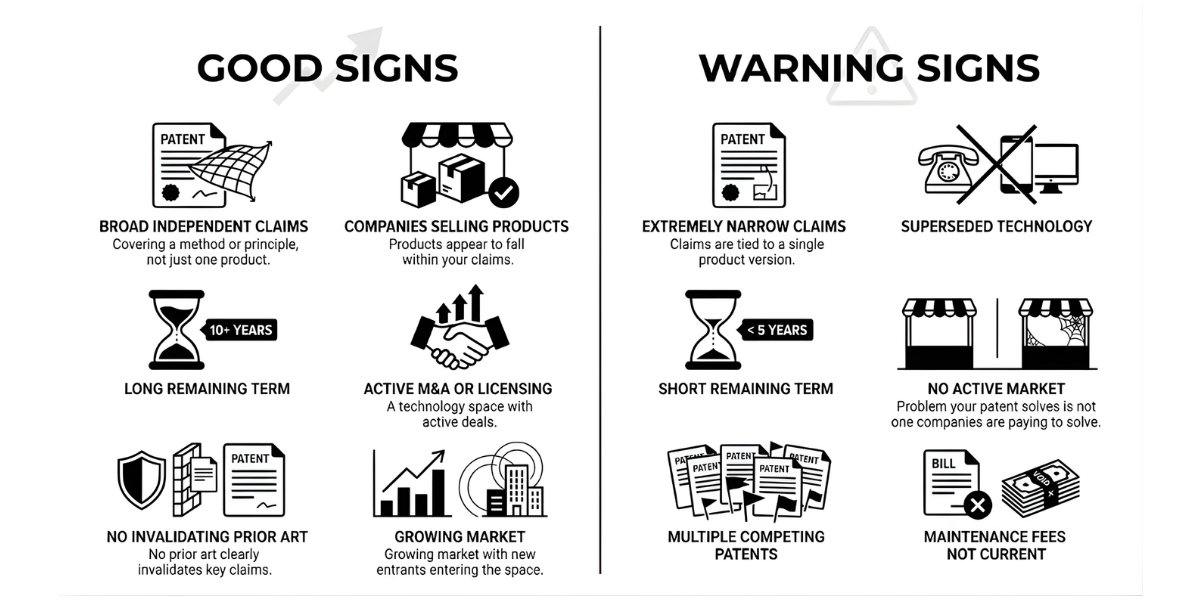
Warning signs do not automatically mean your patent is worthless. But they do mean you need a clearer picture before committing time or money to commercialization.
Not Sure Where Your Patent Stands?
We offer a free 30-minute consult to help you understand your patent’s commercial potential. No sales pitch, just an honest read. Book Your Free Consult
How to Assess Your Patent’s Market Potential Step by Step
Here is a practical sequence you can work through on your own before talking to anyone. It takes a few hours and will give you a much clearer picture of what you are working with.
- Read your independent claims out loudStrip out the legal language and ask: what is the core thing I am claiming ownership of? Write it in plain English. That is what companies would be licensing or infringing.
- Search for products in your marketGo to trade show exhibitor lists, industry publications, and product review sites. Look for products that do what your patent covers. If you find 5 to 10 companies selling in this space, that is a strong market signal.
- Check your expiration datePull your patent on the USPTO Patent Public Search tool. Find your filing date, add 20 years, then subtract any maintenance fee gaps or terminal disclaimers. That is your actual expiration.
- Run a forward citation searchSearch your patent number and look at which companies have cited it in their own patent filings. Companies that have cited your patent often find your technology directly relevant and are your first outreach targets.
- Identify at least 3 named potential licenseesDo not proceed to outreach or valuation until you can name specific companies. If you cannot, spend more time on steps 2 and 4 before moving forward.
- Get a professional read if the signals are positiveIf you find an active market, strong claims, and identifiable targets, a professional patent commercialization assessment is the right next step. It will either confirm the opportunity or identify what is blocking it. Both outcomes are useful.
“The inventors who generate income from their patents are not always the ones with the best technology. They are the ones who treat commercialization as a business process and run it accordingly.”
What to Do If Your Patent Does Have Commercial Potential
If you have worked through the steps above and the signals are positive, the next phase is structured commercialization. Cold emailing companies and hoping for the best rarely works and burns your credibility with the most likely buyers.
A proper commercialization process involves building a target list of companies based on their products and patent citations, preparing a licensing brief that presents your patent in terms they care about (market coverage, claim mapping, remaining term), and making warm introductions where possible. If you are working with a patent licensing consultant, they handle the outreach and negotiation on your behalf.
If you want to understand the full process before committing to anything, the step-by-step licensing guide walks through every stage from target identification to term sheet.
Frequently Asked Questions
How do I know if my patent is worth anything?
A patent has commercial value when it covers a solution that real companies need and cannot easily design around. The four things that matter most are claim strength, market size, remaining term, and whether you can identify a licensee or buyer who benefits from the technology.
What makes a patent commercially valuable?
Commercial value comes from three things aligning: broad, defensible claims that are hard to work around; a product market where companies are actively selling products your patent covers; and a remaining term long enough for a company to recoup its investment in licensing or acquiring it.
Can a patent be worth money even if I never made a product?
Yes. You do not need to manufacture anything to generate income from a patent. Companies license patents from inventors who never built a product. The patent’s value comes from its claims and market coverage, not whether you produced anything.
How long does a patent last, and does it affect value?
Most utility patents last 20 years from the filing date. Remaining term matters because a buyer or licensee needs enough time to commercialize the technology and earn a return. A patent with 3 years left is worth significantly less than one with 12 years remaining.
What should I do if my patent has commercial potential?
The next step is a structured commercialization assessment: identifying the companies most likely to license or buy, reviewing your claims against their products, and preparing an outreach package. A patent commercialization consultant can run this process for you if you do not have the time or industry contacts.
The Bottom Line
Most patents do not generate income. That is not because they lack value. It is because most inventors never run a real assessment, and by the time they try, too much of the patent term has expired.
If you have a granted patent and you have never seriously evaluated its commercial potential, do it now. Work through the six steps above. Check your claims, find the market, identify your targets. If the signals are positive, the window is open. But it does close.